Kerala’s hospital sector has been hiring steadily for the last few years, and not just doctors and nurses. Every hospital, diagnostic chain, and multi-specialty clinic now runs on people who can manage operations, budgets, patient flow, and supply chains behind the scenes. That’s where hospital administration comes in, and it’s turning into one of the more practical career choices for students who want a management role inside healthcare without going the clinical route.
We’ve already covered how to pick the right hospital administration institute. This post is about what happens after you enroll: the actual jobs you can apply for, the skills that get you shortlisted, and what tends to separate a strong candidate from an average one.

The job title sounds generic, but the work is specific. A hospital administrator handles the non-clinical side of running a healthcare facility: staffing schedules, budgets, compliance with health regulations, vendor and supply management, patient billing, and coordination between departments so that doctors and nurses can focus on patient care instead of paperwork.
In smaller hospitals or clinics, one person might handle several of these functions. In larger hospital chains, the work is split across departments, and that’s usually where entry-level graduates start.
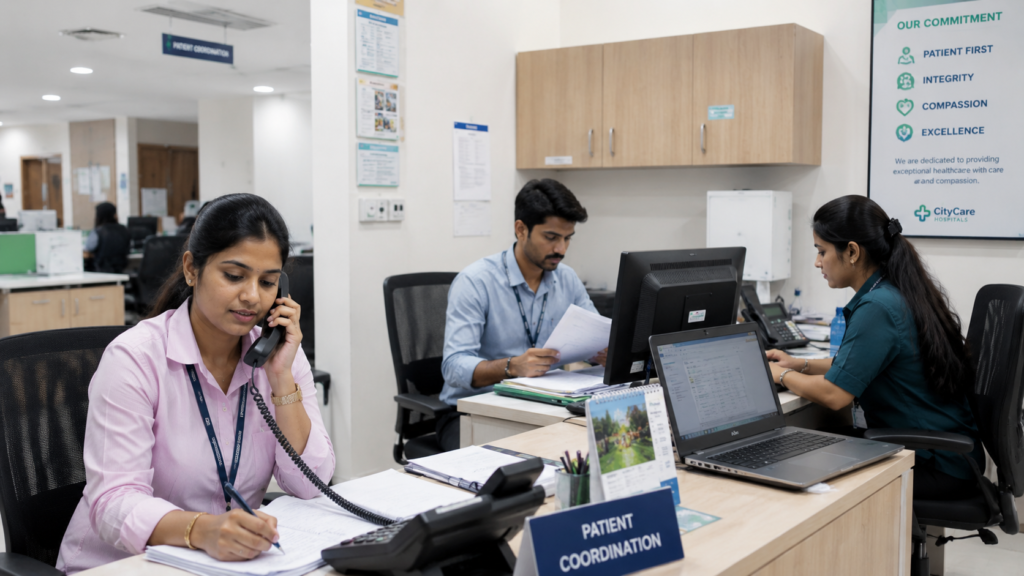
A PG or Professional Diploma in Hospital Administration and Healthcare Supply Chain Management opens doors into several departments, not just one fixed job title. Common entry points include hospital operations executive, patient relations or patient experience coordinator, medical records and health information executive, insurance and billing coordinator, front office and admissions manager, HR executive within a hospital’s administrative wing, and quality control or accreditation coordinator.
Graduates with a supply chain focus also move into healthcare procurement and inventory control roles, ordering and tracking everything from surgical consumables to pharmaceuticals, which hospitals increasingly treat as a specialized function rather than a general purchasing job.
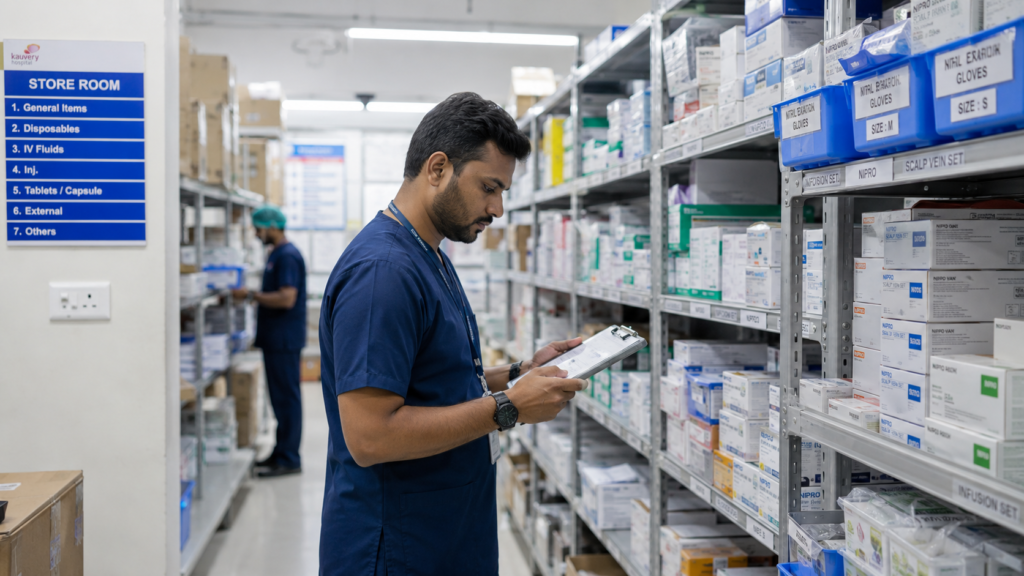
Most hospital administration programs stop at operations and patient coordination. The gap in the market is people who also understand supply chain: inventory control, vendor negotiation, cold chain handling for medicines, and demand forecasting for medical supplies. Hospitals lose money when supplies run short during a shift or expire unused in storage, so this is not a minor add-on skill.
This is also the reason the program at Mithra Institute pairs hospital administration with healthcare supply chain management rather than teaching them separately. A graduate who can manage a ward’s daily operations and also understands how the hospital’s supply chain works is a more versatile hire than someone who only knows one side of it.
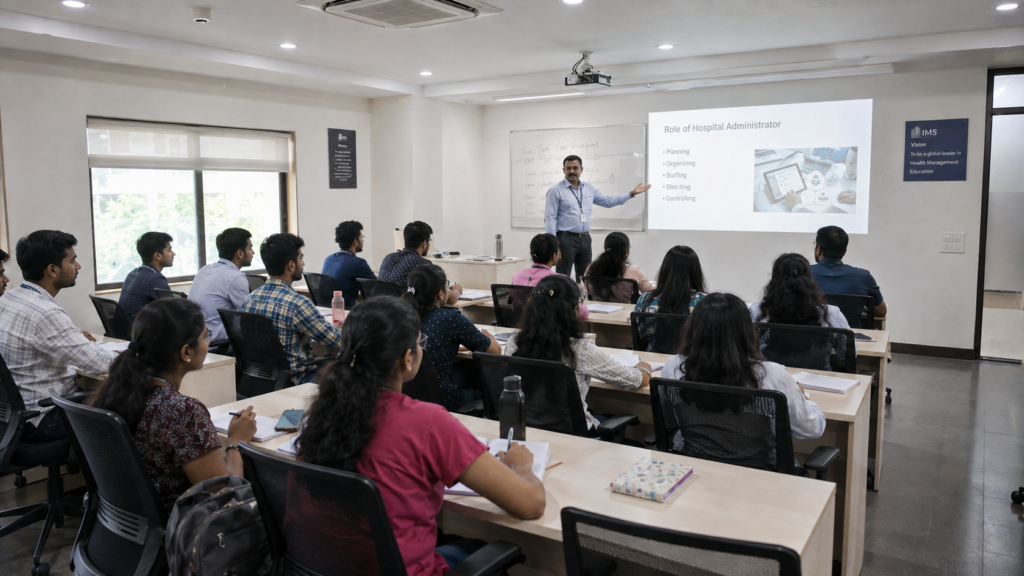
Hospitals hiring for administrative roles tend to screen for a mix of things: comfort with basic healthcare regulations and patient confidentiality norms, working knowledge of hospital management software and billing systems, communication skills for dealing with patients and their families during stressful situations, and enough numerical literacy to handle budgets, insurance claims, and inventory records without constant supervision.
None of this requires a clinical background. It requires training that’s built around how hospitals actually run day to day, which is why practical exposure through internships matters more here than it does in some other management fields.
There’s no single number that applies across the board. Pay depends on the city (metro hospitals in Bangalore or Mumbai generally pay more than tier-2 towns), the size and type of facility (a large multi-specialty hospital chain versus a standalone clinic), and the specific role you land (supply chain and procurement roles often start slightly higher than front-office positions because of the specialized knowledge involved). Certifications, internship performance, and communication skills in English also factor into starting offers, more so than most students expect going in.
How the MIMS program prepares you for this
The PG and Professional Diploma in Hospital Administration and Healthcare Supply Chain Management at Mithra Institute runs 6 to 12 months depending on the track, and admission is open to +2 pass-outs as well as degree holders. The syllabus covers healthcare laws and ethics, financial management in healthcare, hospital operations, public health and epidemiology basics, and the supply chain side: inventory control, procurement, and facility logistics.
Beyond the classroom, the program includes industry internships and live projects, communicative English training, and personality development modules, all aimed at making sure graduates walk into interviews able to talk through real scenarios, not just theory. Classes run across MIMS campuses in Trivandrum, Kazhakuttam, Kallambalam, Ernakulam, Mumbai, and Bangalore, plus online batches for students who can’t relocate.
No. The course covers management and healthcare operations, not clinical medicine, so students from any stream can apply.
Hospital administration covers day-to-day facility operations, patient coordination, and staffing. Healthcare supply chain focuses specifically on procurement, inventory, and logistics for medical supplies. The MIMS program trains you in both.
No. Diagnostic chains, insurance companies, pharmaceutical distributors, and healthcare consultancies also hire people with this background.
Between 6 and 12 months, depending on whether you choose the professional diploma or PG diploma track.
Yes, MIMS offers online batches for students and professionals who need flexibility.
Live projects and internships tied to hospital operations and healthcare supply chain functions, giving students hands-on exposure before they graduate.
Both are accepted. Eligibility is +2 pass or any degree, depending on the specific diploma track.
MIMS runs this program at its Trivandrum, Kazhakuttam, Kallambalam, Ernakulam, Mumbai, and Bangalore campuses, along with online batches.
State Administrative Office
Maheshwari Building, 1st Floor
Opp. Post office, Kazhakuttom – 695582 TVM, Kerala
+91 9656242222
+91 9656271222
info@mimscareer.com
Other Branches
© 2026 MIMS All rights reserved.