The healthcare industry is one of the most important and continuously evolving sectors in the world. Hospitals and healthcare organizations are becoming larger, more technology driven, and more focused on efficiency and patient experience. While doctors, nurses, and other clinical professionals are essential to healthcare delivery, skilled administrators are equally important for ensuring that healthcare organizations operate smoothly.

This is why Hospital Administration is emerging as an attractive career option for students who are interested in healthcare but want to build a career in management, operations, administration, and leadership.
From managing hospital operations and patient services to coordinating employees, finances, technology, procurement, and healthcare supply chains, hospital administrators have an important role in the modern healthcare ecosystem.

Hospital Administration involves managing and coordinating the non-clinical and operational activities of a healthcare organization.
A hospital is a complex organization with multiple departments working together. Doctors and nurses focus on patient care, while administrative teams support the systems that allow those clinical services to function efficiently.
Hospital administration can include areas such as:
The ultimate objective is to improve operational efficiency while supporting quality healthcare and a positive patient experience.
The healthcare sector is changing rapidly. Increasing healthcare awareness, expanding hospitals, technological development, growing patient expectations, and the increasing complexity of healthcare operations are creating new responsibilities for management professionals.
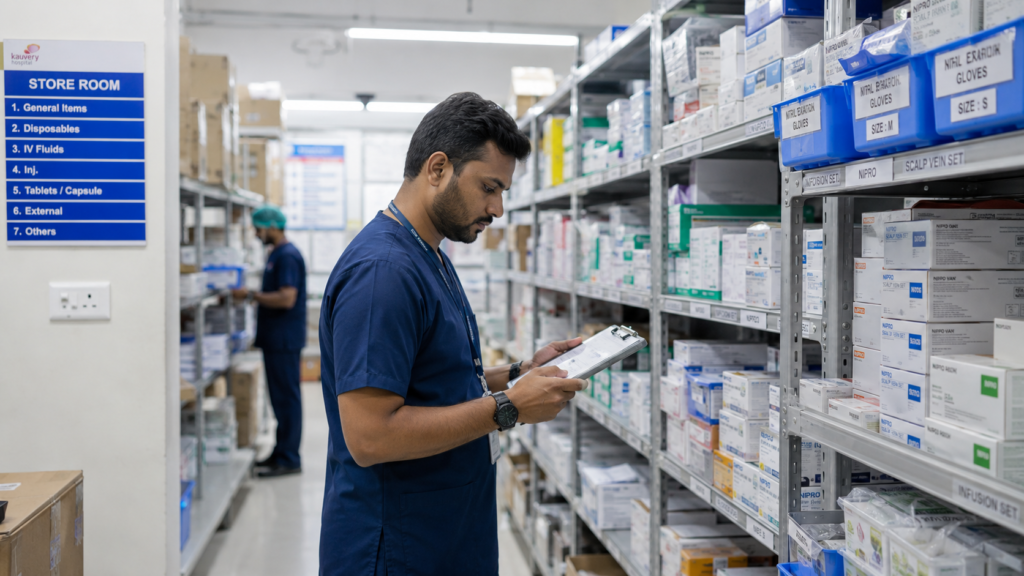
Hospitals today need administrators who can understand not only traditional management principles but also technology, data, healthcare regulations, finance, quality standards, and supply chain processes.
As healthcare organizations continue to evolve, professionals with specialized knowledge in hospital administration can find opportunities across different areas of the industry.
The healthcare sector includes hospitals, clinics, diagnostic centres, specialty centres, rehabilitation facilities, medical laboratories, and other healthcare organizations.
As healthcare services expand, these organizations require professionals to manage their administrative and operational functions.
Hospital administration professionals can contribute to areas such as department coordination, patient services, human resources, procurement, finance, and facility operations.
This creates opportunities for people who want to develop careers on the management side of healthcare.
Patients today expect more than medical treatment. They also value convenient appointments, clear communication, shorter waiting times, organized services, accurate information, and professional support.
Hospital administrators can play an important role in improving the overall patient journey.
Professionals working in patient relations and hospital operations can help organizations identify operational problems and improve service delivery.
This makes patient experience management an increasingly important area within healthcare administration.
Technology is transforming the way hospitals operate.
Digital patient records, hospital management systems, appointment scheduling platforms, telemedicine, healthcare analytics, automated inventory systems, and other digital technologies are becoming increasingly important.
Artificial intelligence and data analytics are also creating new possibilities for healthcare organizations.
Future hospital administrators will therefore need to understand how technology can improve:
Technology will not eliminate the need for healthcare administrators. Instead, professionals who understand both management and technology may be better prepared for the changing healthcare environment.
One of the biggest advantages of Hospital Administration is the variety of career paths available.

A professional can specialize in different areas depending on their interests and skills.
Hospital administrators help manage the overall administrative functions of healthcare organizations.
Their responsibilities can involve coordinating departments, managing resources, supporting staff, monitoring operations, and working with senior management.
Operations professionals focus on improving the efficiency of day to day hospital activities.
They may monitor workflows, coordinate departments, improve processes, and help resolve operational issues.
Patient relations professionals focus on communication and service quality.
They may interact with patients, understand their concerns, coordinate with departments, and help improve the overall patient experience.
Hospitals require large teams of clinical and non clinical employees.
Healthcare HR professionals may be involved in recruitment, employee coordination, training, performance management, and workforce planning.
Financial management is an important part of every healthcare organization.
Professionals can work in areas such as billing, insurance coordination, financial administration, budgeting, and cost management.
Hospitals need medicines, medical equipment, consumables, furniture, technology, and other supplies.
Procurement professionals coordinate purchasing activities, suppliers, documentation, and cost management.
Healthcare supply chain is becoming increasingly important.
Hospitals must ensure that essential products and equipment are available at the right time and in the right quantities.
Professionals can work in:
This is particularly valuable because a hospital administration professional with supply chain knowledge can understand both hospital operations and resource management.
A qualification alone may not be enough to build a successful career. Future healthcare administrators will need a combination of technical knowledge and professional skills.

Hospital administrators communicate with patients, doctors, nurses, employees, suppliers, insurance companies, and management.
Strong communication can help professionals coordinate different departments effectively.
Healthcare organizations require professionals who can lead teams, manage responsibilities, and make informed decisions.
Leadership becomes particularly important as professionals move into managerial positions.
Hospitals can face unexpected challenges, including staffing issues, supply shortages, scheduling problems, and operational delays.
Administrators need to identify problems quickly and develop practical solutions.
Healthcare organizations generate large amounts of operational and financial data.
Professionals who can understand data and use it to support decision-making can provide significant value to their organizations.
Future administrators should become comfortable with digital systems, hospital management software, data analytics, electronic records, and other healthcare technologies.
Hospital administration involves managing multiple departments and responsibilities at the same time.
Strong organizational and time management skills are therefore essential.
Healthcare supply chain management deserves special attention because hospitals depend on the continuous availability of essential resources.
A supply chain disruption can affect hospital operations. Poor inventory management can result in shortages, while excessive inventory can increase costs.
Modern healthcare organizations are therefore looking for more efficient ways to manage procurement, inventory, storage, transportation, and distribution.
Technology is also changing healthcare supply chains through digital tracking, analytics, automation, and improved inventory management.
Students who understand both Hospital Administration and Healthcare Supply Chain Management can develop a broader understanding of how healthcare organizations function.
Hospital administration is a field where practical knowledge is extremely valuable.
Students can learn management concepts in the classroom, but real-world exposure helps them understand how those concepts are applied in healthcare environments.
Internships, practical projects, industry interaction, and on-site training can help students develop:
When choosing a Hospital Administration course, students should therefore consider not only the syllabus but also the practical exposure provided by the institution.
Students interested in this career should carefully evaluate their education options before enrolling.

Important factors include:
Look for a curriculum that covers hospital management, healthcare operations, finance, laws and ethics, public health, human resources, and supply chain management.
Internships and practical projects can help bridge the gap between classroom learning and professional responsibilities.
Experienced faculty can provide valuable academic and industry-oriented guidance.
Career guidance, professional development, networking opportunities, and placement assistance can be useful when starting a career.
Healthcare is changing rapidly, so the course should address modern healthcare practices and technology.
Mithra Institute of Management Studies (MIMS) offers a PG & Professional Diploma in Hospital Administration & Healthcare Supply Chain Management.

The program has a six-month duration and lists +2 or any degree as the eligibility requirement. The course covers areas including hospital management, healthcare laws and ethics, financial management, hospital operations, public health, epidemiology, and healthcare supply chain management. View the MIMS Hospital Administration course
MIMS also highlights practical projects, internships, on-site training, networking opportunities, career guidance, and placement support as part of its professional development approach.
For students looking to enter healthcare management, combining academic knowledge with practical exposure can provide a useful foundation for developing their careers.
The future of hospital administration is closely connected to the future of healthcare itself.
As hospitals become more technology driven and patient-focused, administrators will increasingly be expected to understand:
This means the role of a hospital administrator is evolving.
The future professional may not simply manage paperwork or administrative tasks. They may be involved in data-driven decision-making, digital transformation, process improvement, healthcare quality, resource optimization, and strategic planning.
For students who are interested in healthcare but do not necessarily want to pursue a clinical profession, Hospital Administration can be an interesting career path.
It combines:
Healthcare + Management + Technology + Leadership + Operations
The field offers exposure to multiple aspects of healthcare organizations and can provide opportunities to develop specialized skills.
However, career growth depends on several factors, including education, practical experience, communication skills, specialization, professional development, and individual performance.
Students should therefore focus on building a strong combination of knowledge, practical skills, and industry experience.
Hospital Administration is becoming an increasingly important part of the modern healthcare industry.
The healthcare sector needs professionals who can manage operations, coordinate teams, improve patient services, control resources, understand technology, and support organizational growth.
With the continued development of hospitals, digital healthcare, healthcare technology, and supply chain systems, the future can offer diverse opportunities for trained healthcare management professionals.
For students considering a career in this field, the journey should begin with the right education and practical exposure.
Hospital Administration is not simply about managing hospitals. It is about managing the people, processes, technology, and resources that help healthcare organizations deliver better services.
If you are interested in building a career at the intersection of healthcare and management, Hospital Administration could be a field worth exploring.
No. The course covers management and healthcare operations, not clinical medicine, so students from any stream can apply.
Hospital administration covers day-to-day facility operations, patient coordination, and staffing. Healthcare supply chain focuses specifically on procurement, inventory, and logistics for medical supplies. The MIMS program trains you in both.
No. Diagnostic chains, insurance companies, pharmaceutical distributors, and healthcare consultancies also hire people with this background.
Between 6 and 12 months, depending on whether you choose the professional diploma or PG diploma track.
Yes, MIMS offers online batches for students and professionals who need flexibility.
Live projects and internships tied to hospital operations and healthcare supply chain functions, giving students hands-on exposure before they graduate.
Both are accepted. Eligibility is +2 pass or any degree, depending on the specific diploma track.
MIMS runs this program at its Trivandrum, Kazhakuttam, Kallambalam, Ernakulam, Mumbai, and Bangalore campuses, along with online batches.
State Administrative Office
Maheshwari Building, 1st Floor
Opp. Post office, Kazhakuttom – 695582 TVM, Kerala
+91 9656242222
+91 9656271222
info@mimscareer.com
Other Branches
© 2024 MIMS All rights reserved.